
Most writers won’t say this out loud, but almost every writing decision is driven by fear.
Not fear of grammar. Not fear of deadlines.
Fear of being exposed.
There are two kinds of such fears.
The first is the fear of being misunderstood. You put an idea on the page; someone reads it and misses the point, or worse, draws an entirely different meaning than you intended. So you simplify, sand off the edges, explain too much, and add guardrails, until the idea is safe – and lifeless.
The second fear is more uncomfortable: the fear of being seen as shallow.
This is where writers start piling on words – big ones, dense ones, sentences that tie themselves into a knot – when the idea may be valid, but the writer can’t quite own it with authority. Complexity becomes protection. If the reader doesn’t get it, that’s their problem. At least the writer looks intelligent.
I’ve seen both patterns up close, in myself as well as other writers. Or among teams hired through content writing services that promise clarity but quietly reward compliance. In copywriting services where persuasion slowly turns into politeness because nobody wants to risk sounding too sharp.
Neither fear produces good writing.
When writers are scared of being misunderstood, they overcorrect. They flatten tone. They remove tension. Everything becomes easy to read and easy to forget.
When writers are scared of being shallow, they hide behind heavy language, apply a liberal smattering of SAT-level words without any relevance or meaning, decorate thin ideas to make them look substantial, confuse visible effort with real depth, and quietly hope that complexity will do the thinking they haven’t done themselves.
This is why so much modern content feels off. Not wrong. Just hollow.
The advice to “write simply” was never meant to be a cure-all; it was meant to remove friction, not responsibility, but today that advice is rampant on the internet, repeated so often that it has triggered a quiet race to ultimate dumbification. Simplicity becomes a hiding place rather than a choice, an easy way to avoid the harder task: saying something worth understanding.
Good content writing services don’t just simplify language. They simplify thought without shrinking it. That distinction matters. Most people miss it.
Copywriting services face the same problem. The pressure to be clear, quick, and pleasing can slowly drain the work of its backbone. The copy works. It converts. It leaves nothing behind.
Fear does that. It makes writers play safe. It teaches them to choose approval over precision.
The uncomfortable truth is this: clarity doesn’t come from simplification alone. It comes from conviction. Conviction requires hard work and higher stakes.
When “simple writing” stopped being a choice and became a rule
Somewhere along the way, what began as a personal coping mechanism for anxious writers turned into public advice, and then into something far more rigid, until simple writing stopped being a choice and quietly became a rule, where even a few longer sentences here and there began to invite frowns.
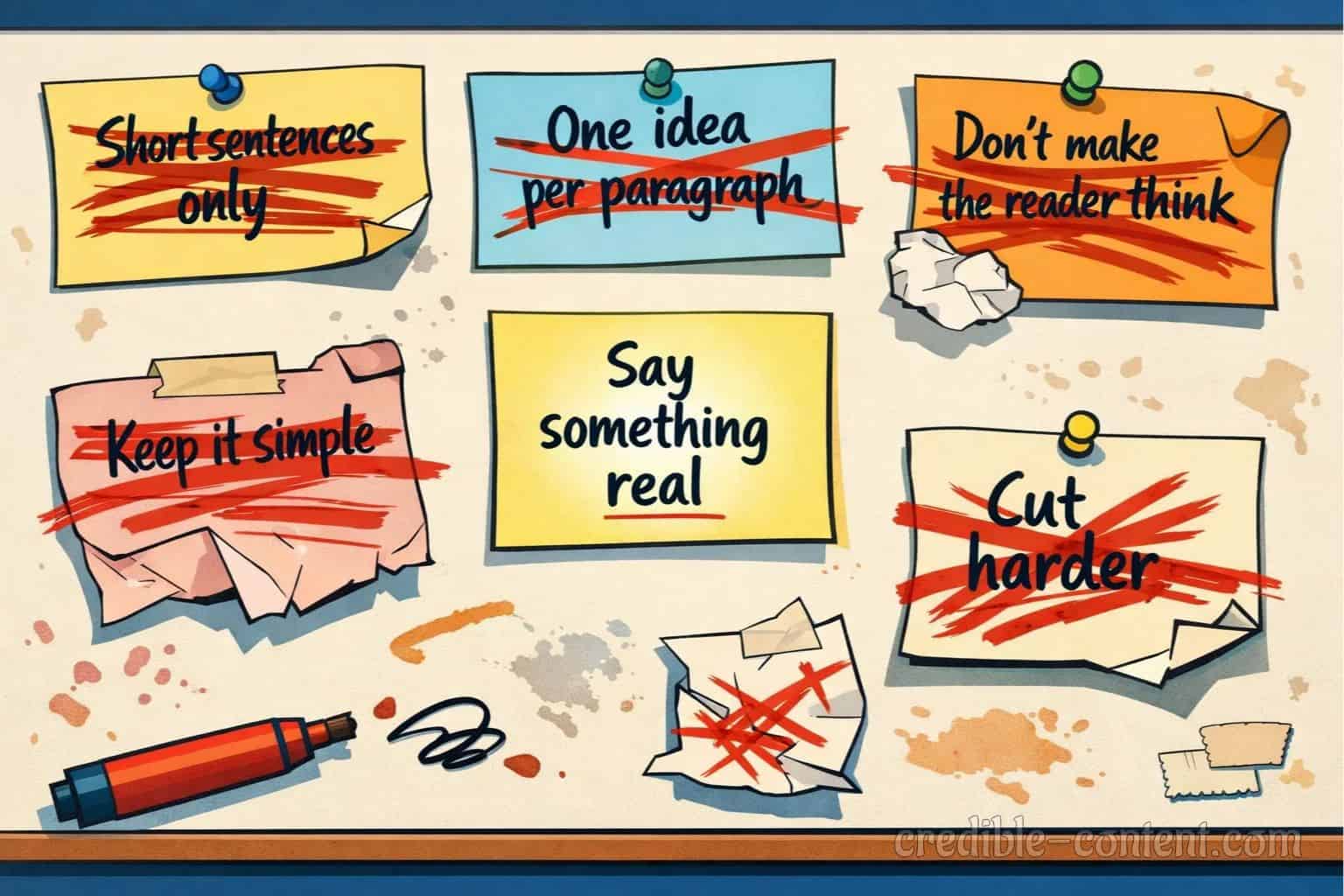
You see the consequences of that shift everywhere now: blog posts, writing threads, courses, checklists, all repeating the same instructions with minor variations – short sentences, one idea per line, cut harder, dumb it down – as if good writing were a mechanical process to be followed rather than a thinking discipline that demands judgment.
The problem isn’t simple writing. The problem is compulsory simplicity. It has become sort of a cult.
What started as a useful correction to bloated, self-important writing has metamorphosed into a doctrine, and once doctrine enters the picture, writers stop thinking and start complying. The writing looks clean. It reads fast. It feels responsible. It also carries very little weight. Fortunately, I have never followed this doctrine.
This is especially visible in the way content writing services operate today. Many sell simplicity as a product, promise “easy-to-read content,” and then deliver writing that feels pre-chewed and predictable, content designed to slide past the reader without leaving a mark. It flows. It scans well. Then it disappears.
The same pattern shows up in copywriting services. The copy is polite, optimised, and safe. It avoids friction at all costs, and in doing so, avoids conviction. It may convert in the short term, but it is hardly convincing, and almost never earns attention a second time. Eventually it becomes ridiculous.
The thing is that simple writing, when it is done well, is a conscious and informed choice. It comes from knowing the subject deeply enough to reduce it without distorting it, and from trusting the reader enough to let meaning do the work instead of spoon-feeding conclusions.
What we have now is something else entirely. The simple writing advice is rampant on the internet, passed around without context or responsibility, until it turns into a race to ultimate dumbification, where the goal is no longer clarity but comfort. The writer feels safe. The reader feels unchallenged.
This is why so much output from content writing services feels interchangeable. Different brands, different industries, the same tone, the same structure, the same emptiness. The writing follows every rule and still manages to say very little.
Experienced writers recognise this instinctively. They know some ideas resist flattening, that certain thoughts need room, texture, and occasionally friction to be understood at all, and that asking readers for attention is not an act of cruelty.
The tragedy is that many writers sense this but suppress it because the market rewards obedience. Copywriting services that question the formula are harder to sell than those that repeat it. Content writing services that insist on thinking move slower than those that churn.
So writers comply. They keep things simple. Too simple. And in the process, they trade judgment for approval.
That trade never ends well.
Readers aren’t fragile. Writers are.
There is a quiet assumption behind most modern writing advice, and it has very little to do with readers.
The assumption is that readers are impatient, distracted, and easily overwhelmed, and that unless everything is kept short, smooth, and immediately digestible, they will leave. So writers bend. They anticipate confusion. They explain before the reader has a chance to think. They smooth out tone to avoid friction.
This assumption is wrong.
Readers are not fragile. Writers are.
Writers are the ones afraid of losing attention. Afraid of being misunderstood. Afraid of being judged for asking too much. So they lower the bar, not because the idea demands it, but because the writer does.
I’ve written for publications where editors trusted readers enough to let an argument unfold, to let a paragraph run longer than usual, to let a thought arrive late instead of being announced upfront. Those pieces were not easy in the shallow sense. They were read. They were remembered. They were argued with.
Now look at much of what comes out of content writing services. The work is meant to remove every possible obstacle, including the ones that make reading worthwhile. “Don’t make your reader think,” they say, which is the stupidest advice I have come across. Readers should be made to think, as long as that thinking is not distracting or confusing. Don’t distract your readers. Don’t confuse them. Don’t mislead them. But there is no harm, none at all, in making them think.
Copywriting services fall into the same trap. In the rush to be clear, quick, and persuasive, the copy loses tension. It avoids ambiguity. It avoids risk. It avoids saying anything that might slow the reader down. The result is writing that functions but does not stay.
Asking readers to make a small effort is not elitism. It is respect. It assumes intelligence. It assumes curiosity. It assumes that meaning is something the reader meets halfway, not something handed over fully formed.
Good writing can slow the reader down. It can ask for attention. It can demand a second look. None of this is cruelty. It is how ideas settle and take root in another person’s mind.
The belief that readers need to be shielded from difficulty says more about the writer’s insecurity than the reader’s capacity. It signals a lack of trust, not just in the audience, but in the idea itself.
This is why the safest writing often feels the most insulting. It talks down without knowing it. It mistakes comfort for care.
Readers don’t need to be coddled. They need something worth their time.
Complexity that comes from honesty, not showing off
Not all complexity is a performance.
Some ideas can be messy. They can make you uncomfortable. They can appear like a jigsaw puzzle that the reader needs to arrange before any real benefit emerges. This messiness is not a flaw. It is often a sign that the idea has not been flattened for convenience.
When writers stay honest to such ideas, the writing becomes a little harder. Sentences stretch. Paragraphs carry more than one impulse. This does not come from vanity. It comes from refusing to lie for the sake of ease.
The common mistake is to assume that any difficulty in writing signals ego. That reading is lazy. Sometimes complexity comes from precision, from resisting the urge to round off corners just to keep the reader comfortable.
I have written pieces where simplifying the language further would have meant lying about the idea. Not exaggerating it. Lying. Some arguments need scaffolding. Some thoughts need to be approached from more than one side. Cutting too much does not clarify them. It distorts them.
This is where experienced writers draw a line that beginners often miss. They know the difference between unnecessary complication and necessary density. They can feel when a longer sentence is carrying weight and when it is merely filling space. That judgment does not come from rules. It comes from time spent thinking, writing, and rewriting.
I would quickly add that sometimes a sense of complexity is introduced by novice writers simply because they want to impress. Writing done to impress rarely carries meaning and almost always feels hollow to experienced readers. In that sense, the more you write, the more no-nonsense your writing tends to become, but that is a different issue altogether.
This distinction matters deeply in content writing services. Businesses do not need content that is merely easy to read. They need content that is accurate, grounded, and capable of holding a complex idea without collapsing under it. Oversimplified content may attract clicks, but it rarely builds trust.
The same applies to copywriting services. Persuasion does not always come from smoothness. Sometimes it comes from naming the thing clearly, even if doing so slows the reader down. A reader who pauses because something rings true is far more valuable than one who skims past everything.
Honest complexity respects both the idea and the reader. It does not hide behind jargon, nor does it rush to dilute meaning. It accepts that some effort is part of understanding, and that not every thought can be compressed without loss.
The danger is not complexity. The danger is dishonesty, whether it appears as bloated language or as excessive simplification.