

Do you think blogging is dead in the time of AI?
Do you feel like nobody reads blogs anymore because ChatGPT, Gemini, Perplexity, LinkedIn posts, short videos, and newsletters have taken over?
That’s a fair doubt. Almost everyone has it.
Every few years, blogging is declared dead. Loudly. With confidence. With charts and hot takes.
First, social media was supposed to kill blogging. Then YouTube was the final nail in the coffin. Then email marketing took over. Now AI has apparently buried it for good.
Yet blogging refuses to die. It’s growing. Right in front of us.
The numbers I’m going to share in this blog post are going to surprise you. Not because they are flashy, but because they directly contradict what most people casually believe about blogs in 2025-26.
Before we get into the data, let me be clear about one thing.
This is not a motivational post about “why you should start a blog today.” And this is definitely not one of those how-to guides packed with hacks, templates, or growth tricks.
Want to know how to get your content featured by various AI tools? You may like to read How to write content that makes AI recommend your business?
Back to this blog post: it is about the relevance of blogging, about attention, and about why businesses that quietly keep investing in blog writing services are still winning long-term while others chase the next shiny thing.
I came across an infographic on LinkedIn recently from SEMRush that questioned the claim that AI has killed blogging. That post stopped me mid-scroll. Not because it was shocking, but because I have seen this cycle before.
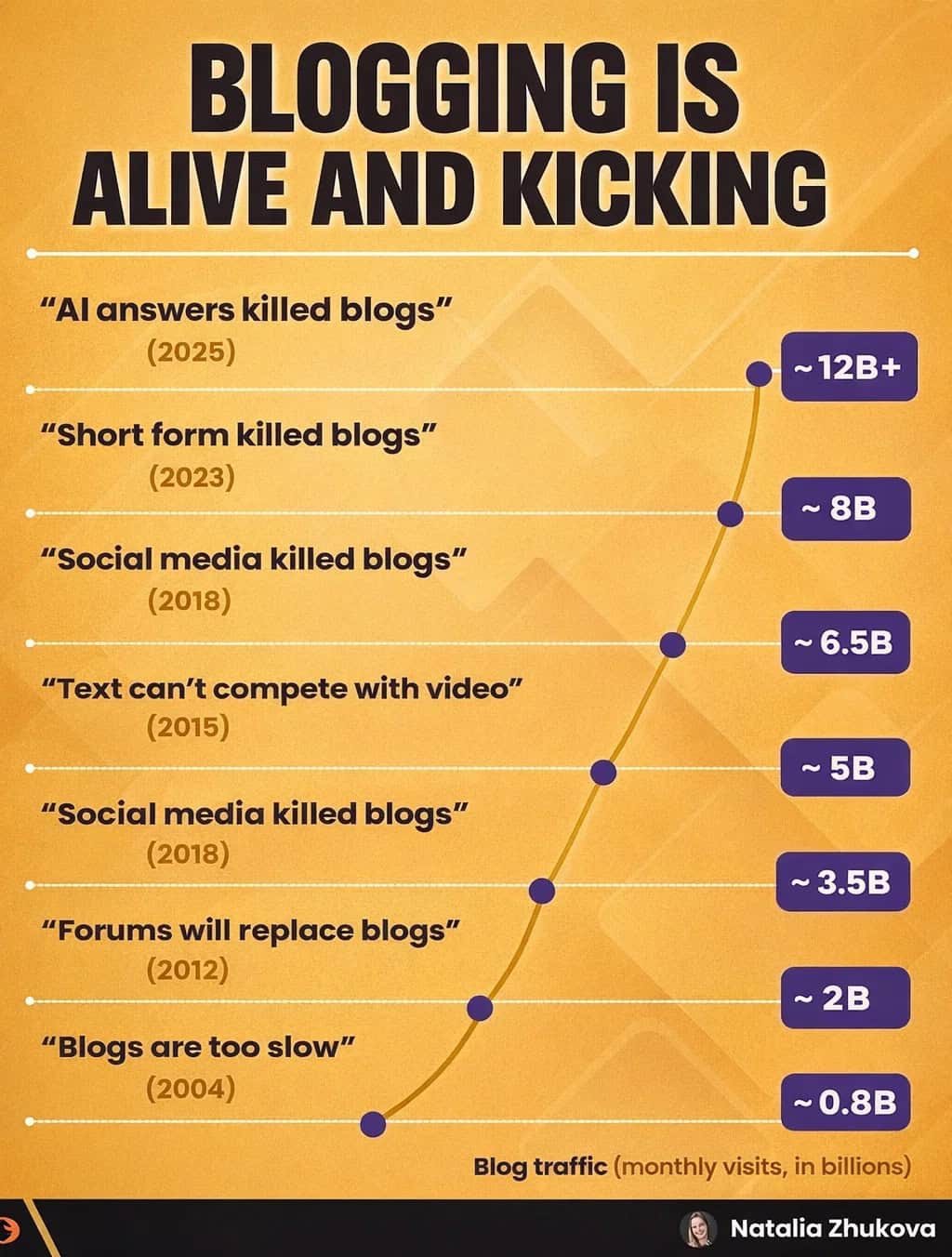
People once said blogs would disappear because nobody had time to read long-form content. Then they said nobody would search anymore because social feeds would replace search. Today, they say AI summaries have removed the need to click.
Each time, the format changed a little. But the behaviour did not.
- People still look for answers.
- They still research before buying.
- They still want depth when something matters.
- Businesses still need a stable place on the internet that they own.
That place is still the blog.
Let’s look at the scale first.
Back in 2004, all blogs combined attracted roughly 0.8 billion visits per month. In 2015, that number jumped to around 5 billion. As of 2025-26, blogs attract close to 12 billion visitors every single month. Not yearly. Monthly.
If blogging were irrelevant, these numbers would be going down, not tripling.
WordPress.com alone hosts around 17-18 million new posts every month (source). That’s just one platform. On top of that, there are an estimated 500-600 million blogs hosted on independent websites using WordPress as a CMS. About 43-44% of all websites today run on WordPress, whether they are blogs, business sites, or a mix of both.
Medium doesn’t publish its numbers publicly, but estimates suggest around 1.3-1.4 million new posts every month. Across platforms like WordPress, Tumblr, Wix, Medium, and LinkedIn, there are over 700 million blogs (source). Between 4 to 5 million blog posts are published every single day, adding up to more than 1.5 billion posts per year.
These are not vanity figures. These numbers exist because there is demand.
Here’s where it gets more interesting.
As of 2025-26, around 80-90% of content marketers still include blogging as their most used content format (source). Businesses that blog consistently see about 55% more website visitors and are 13x more likely to report positive ROI from their marketing efforts. Over 50% of blog traffic still comes from organic search.
Despite AI. Despite short attention spans. Despite everything.
This is where the conversation usually gets shallow. People say, “Yes, blogs exist, but they don’t work anymore.”
That’s not accurate.
What doesn’t work is low-effort blogging. Thin posts. Generic advice. Content created only to fill a calendar. AI-written fluff published without thinking.
Today, around 65-90% of content marketers use AI tools to ideate, draft, or optimise blog content (source). But human editing, judgment, and subject understanding remain critical for performance. AI has changed the process, not the need for quality.
Search itself has changed too. AI Overviews and similar features have reduced organic clicks for many educational posts. Especially those written only to rank for simple questions. When the answer is fully visible on the results page, there’s no reason to click.
But here’s the part people miss.
- AI tools still need sources.
- They still pull information from blogs.
- They still link back to original articles.
Good blogs haven’t lost relevance. Weak blogs have.
Traffic today is not just about volume. Relevance matters more. Well-researched posts with original insights consistently outperform generic content. This is why businesses that rely on business blogging services focused on expertise are seeing results, while others quietly fade.
One of the biggest problems blogs face right now is not AI. It’s trust. Too much content looks the same. Sounds the same. Says nothing new.
That’s why human-written blogs are becoming more valuable, not less. High-quality blogs build brand, trust, and community over time. They signal seriousness. They show thinking. They attract the right audience, not just any audience.
HubSpot reports that blogging has become more AI-assisted, but the shift has been towards higher-value, data-backed content instead of plain quantity (source).
Among companies still publishing blogs regularly, 47% say blogging is very important to their marketing strategy, and 46% say it is important. Only a tiny fraction see it as unimportant. Around 45% of marketers plan to increase their blogging budget in 2025, while only 13% plan to reduce it (source).
That tells you where experienced marketers are placing their bets.
Certain formats perform better than others. How-to guides still lead at 51%, followed by industry news at 45%, case studies at 42%, and deep explainer articles at 34%. Product listicles trail behind at 23%.
And despite everything, 38% of businesses still rely heavily on organic traffic for their blogs.
From personal experience, I would say that AI has not lowered the quality of blogging. It has raised the bar. Output has increased, yes, but so has the expectation. Primary source citations are more common now. Original research is being published more often. Expert review processes are becoming standard. Fact-checking matters again.
This is exactly why working with a skilled content writer for blogging makes such a difference today. Not someone who just knows how to prompt AI, but someone who understands context, positioning, tone, and audience. Someone who knows when to go deep and when to stop. Someone who can turn blog writing services into a long-term business asset instead of a publishing chore.
Blog traffic hasn’t declined. It has grown. From under a billion monthly visits in 2004 to around 12 billion visits per month in 2025–26. That alone should end the “blogging is dead” debate.
Blog publishing hasn’t slowed either. Millions of new posts every day. Hundreds of millions of blogs across platforms. WordPress still powers nearly half the web. Medium continues to publish at scale. Businesses continue to rely on organic traffic. Content marketers still prioritize blogging over every other format.
If blogging were irrelevant, budgets would shrink. Instead, many are increasing. If blogs didn’t work, companies wouldn’t keep investing time, people, and money into them. They would quietly move on. They haven’t.
What has changed is the tolerance for rubbish.
Thin posts. Generic advice. AI-generated filler written for nobody in particular. That kind of blogging is done. Rightfully so. Search engines don’t reward it. Readers don’t trust it. AI summaries replace it without effort.
What survives, and actually grows, is relevance.
Blogs that add something to the conversation. Blogs that are written by people who understand the subject. Blogs that show thinking, experience, judgment, and sometimes even uncertainty. Those blogs still get read. Still get linked. Still get cited by AI tools. Still influence buying decisions quietly in the background.
This is why working with proper blog writing services matters more now than it ever did. The need today isn’t more content. It’s better content. A handful of posts that actually do the work will always matter more than dozens published just to fill space.
The same applies to choosing a content writer for blogging. This is no longer about who can type fast or prompt well. It’s about who can think, connect dots, interpret data, and write in a way that actually helps the reader. Someone who understands that a blog post is not just traffic bait, but a public record of how your business thinks.
Businesses that treat blogging seriously are not chasing algorithms. They are building assets. Over time. With patience. With intent.